
Ancient Tunisia — 5 days
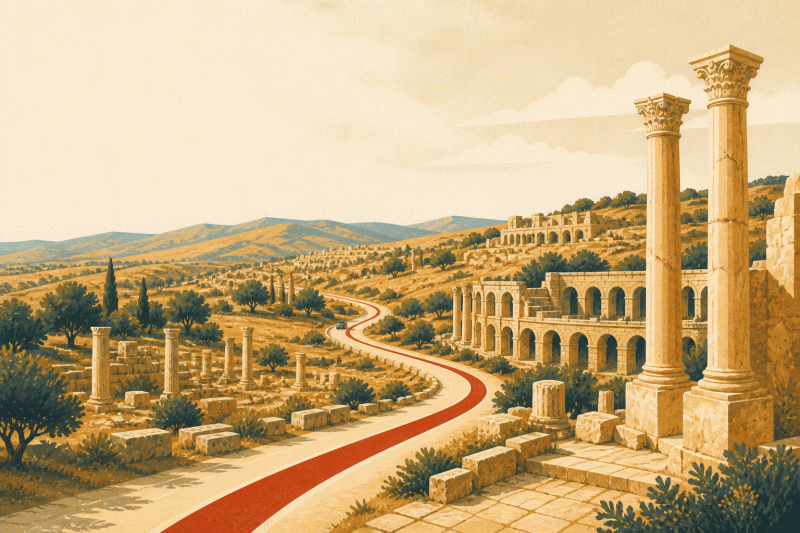
Five days among Roman and Numidian sites, in a vehicle kept for your group alone, from Carthage down to El Jem.
Eight unhurried days reading Tunisia layer by layer, from Punic Carthage to the Ottoman medinas, with time to linger wherever a place holds you.
On request
Duration
8 days / 7 nights
Who it suits
Travellers who want depth: archaeology and Roman history enthusiasts, lovers of Islamic art, families with older children, small groups of friends.
Price
On request
Eight days reading Tunisia's civilisations in the order they were built: the Punic harbours of Carthage, the Bardo mosaics, untouched Kerkouane, Roman Dougga and the underground villas of Bulla Regia, Aghlabid Kairouan, El Jem and the medina of Sousse. Your own vehicle, your own pace, real time at every site.
Departures
Greater Tunis: Tunis-Carthage airport, your hotel, or the La Goulette cruise terminal. Hammamet, Nabeul, Sousse or Monastir, with the route reordered to suit the starting point.
A working plan rather than a fixed track: the order of the days is reworked with you before departure, and on the road wherever that is practical.
Day 1 — Arrival, Carthage and Sidi Bou Said
We collect you at the airport, your hotel or the La Goulette quay, then climb Byrsa hill to see exactly what Carthage was watching for out at sea. The circular Punic harbours, the Antonine baths open to the gulf, the Roman villa quarter. The day ends in the blue-and-white lanes of Sidi Bou Said, which empty out pleasantly late in the afternoon.
Day 2 — The Bardo and the Tunis medina
The morning goes to the Bardo Museum, housed in a beylical palace: the world's largest collection of Roman mosaics, many of them lifted from the very sites you will stand in later this week. In the afternoon we walk the medina, from the Zitouna mosque through the chechia and perfume souks to the carved doorways of the Ottoman palaces and the quiet turn towards Dar Ben Abdallah.
Day 3 — Cap Bon: Kerkouane and Kelibia
We drive out through the citrus country of Cap Bon. Kerkouane is the one Punic town the Romans never built over: house plans, the distinctive hip-bath basins, streets running intact towards the sea, all of which makes it unusually easy to read for a site of its age. Fish lunch in Kelibia, the fortress above the coast, then back towards Tunis.
Day 4 — Testour, Dougga and the Medjerda valley
We head inland along the Medjerda valley. A stop at Testour, founded by Andalusians expelled from Spain and known for the minaret with its backwards clock. Then Dougga, the best preserved Roman town in North Africa: the capitol still standing, the theatre cut into the slope, the Libyco-Punic mausoleum and a vast view over wheat country. Night near Le Kef or Teboursouk.
Day 5 — Bulla Regia and the Chemtou quarries
Bulla Regia and its underground villas, dug out to escape the summer heat: you go down a flight of steps and walk on mosaics still lying exactly where they were laid. Nearby, Chemtou, whose yellow marble veined with pink was quarried for Rome and floated downriver. Then the drive to Kairouan, long but steady, across the grain plains.
Day 6 — Kairouan, first capital of Ifriqiya
A full day in the Aghlabid city: the Great Mosque, its white courtyard bristling with columns salvaged from older Roman sites, the Aghlabid basins that once watered the town, the blue-tiled zaouia of Sidi Sahbi, and the medina with its carpet workshops. Kairouan rewards a slow pace, working through shaded lanes between glasses of pine-nut tea.
Day 7 — El Jem and the Sousse medina
The amphitheatre at El Jem rises out of the olive groves almost whole, and you can walk the underground galleries that lifted animals and gladiators into the arena. The small museum next door holds some superb mosaics. In the afternoon, Sousse: the early Islamic ribat, the plain and powerful great mosque, the walled medina and the ramparts at sunset.
Day 8 — Zaghouan, Thuburbo Majus and return
We work our way north through the interior. Thuburbo Majus is quiet and little visited, so its forum and baths are often yours alone. At the foot of Djebel Zaghouan, the Water Temple marks the spring that supplied Carthage through the aqueduct whose arches still stride across the plain. Drop-off at the airport, your hotel or the port, at the time agreed with you.
It is not compulsory, and plenty of travellers do very well with a good site plan and a book. On a route this archaeological, though, a licensed guide adds real depth at Carthage, Dougga and Kairouan. It is a separate service that we book in advance at your request, either for particular sites or for the whole tour.
Yes. The itinerary is a starting point rather than a fixed timetable. Depending on where you land, the season, museum closing days and whether you lean Roman or Islamic, we reshuffle the stages and adjust the overnight stops. Tell us what matters most to you and we build the quote around that.
It does, provided the day is built differently: open sites first thing, a long lunch and a rest, then museums and shaded medinas later on. The vehicle is air-conditioned and the driving is done during the hottest hours. Spring and autumn remain the most comfortable seasons for long walks around the ruins.
Five days among Roman and Numidian sites, in a vehicle kept for your group alone, from Carthage down to El Jem.
Our most complete route, driven end to end: Mediterranean to dunes, in a vehicle nobody else shares.
Two Roman cities in one day: Dougga up in the wind on its hillside, then Bulla Regia, where people went underground to live, with the mosaics still lying where they were laid.
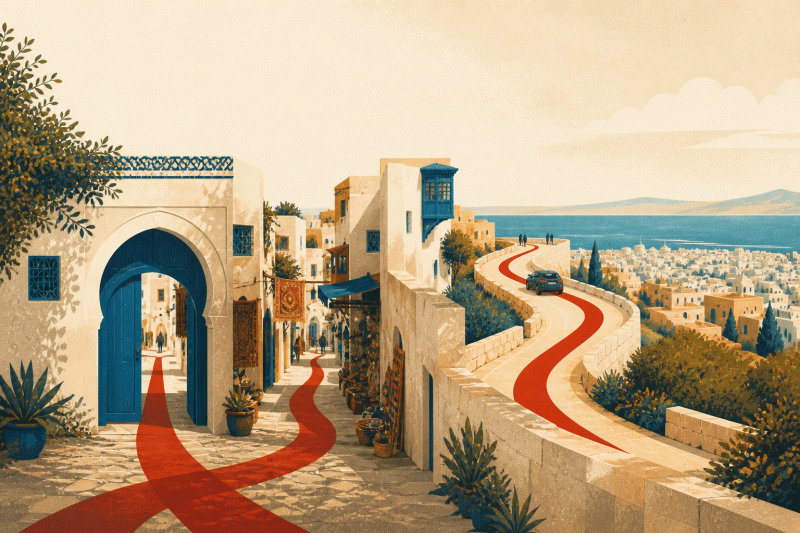
Islam's fourth holy city in the morning, the largest Roman amphitheatre in Africa after lunch.
Your dates, how many of you are travelling and where you start are enough to begin: we come back with a quote drawn up for this tour.
Fields not marked optional are needed to prepare a quote.
Every journey is quoted individually: no price is shown before your own quote.