
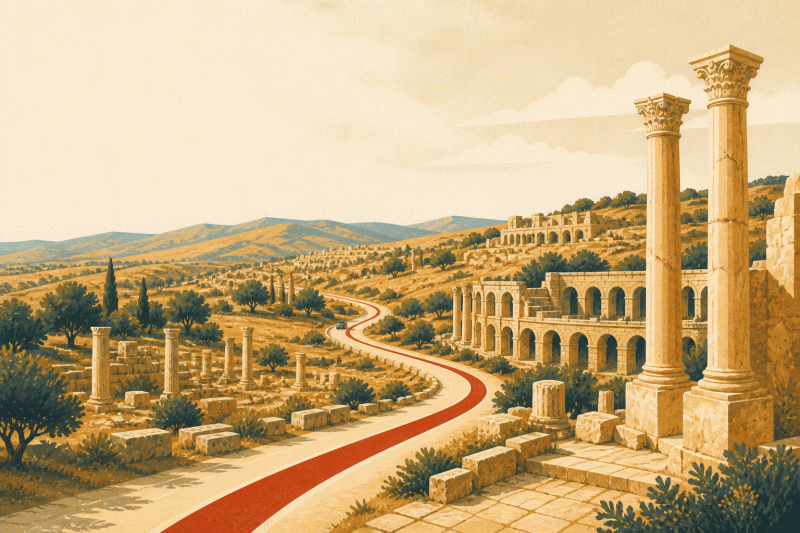
Tunisia Heritage Tour — 8 days
Eight unhurried days reading Tunisia layer by layer, from Punic Carthage to the Ottoman medinas, with time to linger wherever a place holds you.
Five days among Roman and Numidian sites, in a vehicle kept for your group alone, from Carthage down to El Jem.
On request
Duration
5 days and 4 nights, from the first morning to the agreed return
Who it suits
History and archaeology enthusiasts, curious couples, site photographers and families with teenagers
Price
On request
Built for travellers who actually read the site panels. The scattered enclosures of Carthage, the Bardo mosaics, the open capitol of Thuburbo Majus, Dougga on its ridge, the underground villas of Bulla Regia, and El Jem's amphitheatre with its museum. The vehicle is yours, so a room of mosaics can take as long as it takes.
Departures
Departures from Tunis, La Marsa, Gammarth or Sidi Bou Said. Pick-up at Tunis-Carthage or Enfidha-Hammamet airport on the day you land. Departures from Hammamet or Sousse are possible, with the running order reshuffled to suit.
A working plan rather than a fixed track: the order of the days is reworked with you before departure, and on the road wherever that is practical.
Day 1 — Carthage and the Bardo mosaics
Carthage is not one site but a scatter of enclosures spread over several kilometres: Byrsa hill, the Antonine Baths above the sea, the Punic ports, the tophet, the amphitheatre. Your vehicle moves with you between them instead of leaving you to walk the gaps. In the afternoon the Bardo gathers the mosaics lifted from Sousse, El Jem and Dougga, so you meet indoors the very places you are about to walk.
Day 2 — Zaghouan's water temple and Thuburbo Majus
At the foot of Djebel Zaghouan, the water temple marks the spring captured to supply Carthage; the aqueduct's arches then surface again across the plain, right beside the road. Thuburbo Majus, near El Fahs, opens onto a forum, a capitol whose columns are still standing and the palaestra of the Petronii, in a quiet few sites keep. The ground is bare and fully exposed, so out here a hat matters as much as your notebook.
Day 3 — Dougga, a Roman town on its ridge
Dougga spreads across a whole hillside above the valley: a theatre cut into the slope, an almost complete capitol, the Cyclops baths with their communal latrines, and the Libyco-Punic mausoleum below. Allow a solid two to three hours of walking on uneven paving, with real climbing in it. On the way, Testour and its Andalusian mosque are worth the stop when the day allows, and the drive back runs through the hills around Teboursouk.
Day 4 — Bulla Regia and its underground villas
At Bulla Regia the residents built downwards to escape the heat: a few steps take you into cool rooms where the mosaics have stayed exactly where they were laid, Amphitrite first among them. Chemtou, close by, keeps the Numidian marble quarries and a museum explaining how the stone was cut and shipped. The day ends with the drive to your next overnight stop, chosen with you when the quote is drawn up.
Day 5 — El Jem, the amphitheatre and its museum
The Thysdrus amphitheatre rises straight out of a small town's rooftops with almost no warning: you climb into the tiers, then go down into the galleries where animals and prisoners were held. Minutes away, the archaeological museum holds the House of Africa and mosaics whose cousins you met at the Bardo, closing the circuit where it opened. Afterwards, the drive back to Tunis, the Sahel or the agreed airport, at the timing set out in your quote.
Naceur drives: he handles the roads, the access points and the parking, and gives you the time you need on site. If you want expert commentary at Carthage, Dougga or the Bardo, a licensed guide can be arranged on request and is billed separately. Plenty of travellers prefer their own reading and a quiet site, and that works just as well.
It does, provided the day is turned around: an early start, open-air sites in the morning, cool museum rooms through the worst of the heat, then back out in the late afternoon when the light rakes across Dougga. Thuburbo Majus and Dougga offer next to no shade, so water, hats and breaks in the shade of the vehicle are part of the plan.
Dougga means climbing and uneven paving, Bulla Regia means steps down into the villas, and El Jem means tiers of seating. Carthage is split between enclosures you reach by road, which cuts the walking considerably. Tell us about any mobility limits when you ask for a quote: some stops can be swapped, others simply shortened.
Eight unhurried days reading Tunisia layer by layer, from Punic Carthage to the Ottoman medinas, with time to linger wherever a place holds you.
Two Roman cities in one day: Dougga up in the wind on its hillside, then Bulla Regia, where people went underground to live, with the mosaics still lying where they were laid.
A Roman temple built against the mountain, the aqueduct that carried its water to Carthage, and a forum you often have to yourself.
Islam's fourth holy city in the morning, the largest Roman amphitheatre in Africa after lunch.
Your dates, how many of you are travelling and where you start are enough to begin: we come back with a quote drawn up for this tour.
Fields not marked optional are needed to prepare a quote.
Every journey is quoted individually: no price is shown before your own quote.