
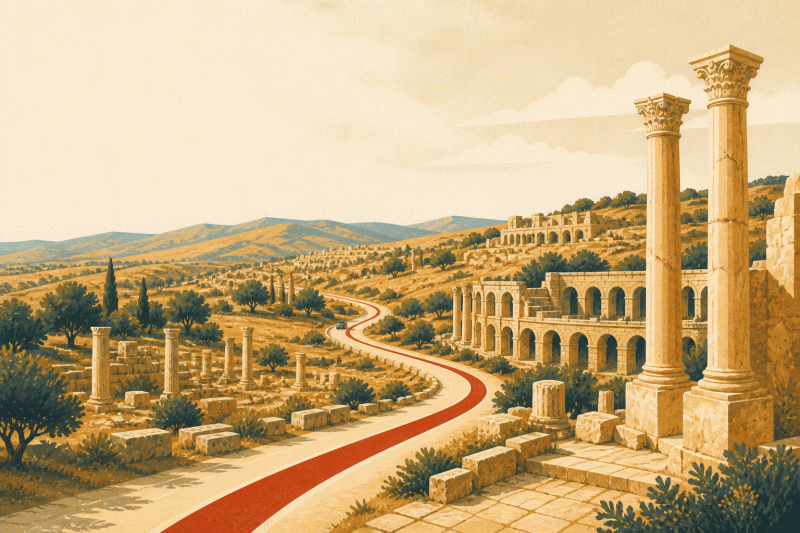
Dougga and Testour
A day in the Medjerda valley: the best-preserved Roman town in North Africa in the morning, a small town founded by Andalusian exiles in the afternoon, and a vehicle nobody shares with you in between.
A Roman temple built against the mountain, the aqueduct that carried its water to Carthage, and a forum you often have to yourself.
On request
Duration
A full day out of Tunis without long distances; the departure time is agreed with you in the quote.
Who it suits
Anyone interested in Roman archaeology, gentle walkers, photographers, and families after sites without the crowds.
Price
On request
An hour from Tunis the air changes: Djebel Zaghouan stands over the plain, and the Roman water temple is built against the spring itself, a half-circle of niches around its basin. From there the aqueduct crosses the fields on arches still standing. Further south, Thuburbo Majus lays out its forum, capitol and baths in near silence.
Pick-up
Pick-up at your hotel or address in Tunis, La Marsa, Gammarth, Carthage or the northern suburbs. We can also start from Hammamet, Nabeul or Sousse: the order of the stops adapts, and the timing is settled with you in the quote.
The order of the stops shifts with your start time, the traffic and how long you want to spend at each place.
Zaghouan and the water temple
The road climbs towards Djebel Zaghouan and the air cools noticeably. Above the town, the water temple encloses the spring in a half-circle of niches facing a basin, with the mountain behind it: this is where Rome sent its water off towards the coast. Below, the old town keeps its stepped lanes, arcaded houses and fountains that still run.
The Roman aqueduct, towards Mohammedia
Between Zaghouan and Tunis the aqueduct resurfaces in stretches across the fields, and near Mohammedia the arches reach their full height and march off towards the horizon. Standing underneath is the only way to grasp the scale of it: tens of kilometres of calculated fall, laid out to keep Carthage supplied. Depending on which way round we run the day, we follow it on the way out or on the way back.
Thuburbo Majus
On a hill above the El Fahs plain, Thuburbo Majus spreads out a colonnaded forum, a capitol whose columns still stand, baths, a palaestra and mosaics left where they were laid. The site is big and rarely busy: you can walk it for a long while without meeting anyone, among olive trees and blocks of honey-coloured limestone. This is the stop that deserves the most time.
It rounds Carthage out rather than repeating it: Zaghouan and the aqueduct explain where the water in the Antonine baths came from, while Thuburbo Majus shows a provincial Roman town whose plan is still legible. Plenty of travellers pair the two across two days, in whichever order suits.
Nothing strenuous, but plenty of uneven ground. The water temple takes a few steps, the aqueduct stop is brief, and Thuburbo Majus is a slow wander over ancient paving that has shifted over the centuries. Closed shoes are enough, and we fit the length of each stop to your pace.
The site has little signage and gains a great deal from being explained: without commentary the capitol and the baths are handsome but hard to read. Your driver drops you at the entrance and waits, and a licensed guide can be booked separately for that visit, on request.
A day in the Medjerda valley: the best-preserved Roman town in North Africa in the morning, a small town founded by Andalusian exiles in the afternoon, and a vehicle nobody shares with you in between.
Mosaics first, ruins after: the Bardo while the galleries are still quiet, then the archaeological sites of Carthage, and a last hour among the blue doors of Sidi Bou Said.
Five days among Roman and Numidian sites, in a vehicle kept for your group alone, from Carthage down to El Jem.
Give us the date, how many of you are travelling and your pick-up address: we reply with a quote drawn up for this day out.
Fields not marked optional are needed to prepare a quote.
Every journey is quoted individually: no price is shown before your own quote.