
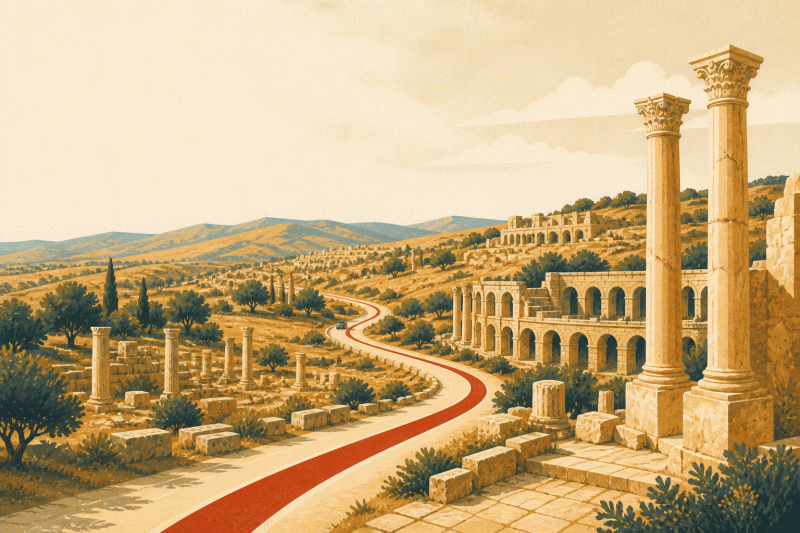
Dougga and Bulla Regia
Two Roman cities in one day: Dougga up in the wind on its hillside, then Bulla Regia, where people went underground to live, with the mosaics still lying where they were laid.
A day in the Medjerda valley: the best-preserved Roman town in North Africa in the morning, a small town founded by Andalusian exiles in the afternoon, and a vehicle nobody shares with you in between.
On request
Duration
A full day, roughly 9 to 10 hours depending on where we collect you.
Who it suits
Anyone drawn to archaeology and Andalusian history, families with children who can walk, photographers, and travellers who would rather see two places properly than five in passing.
Price
On request
Two hours out of Tunis and you are in wheat country. Dougga stands on a hillside above the Oued Khalled valley: capitol, theatre, Roman arch and a Libyco-Punic mausoleum among the olive trees. The afternoon belongs to Testour, a town of ruled-straight streets, tiled roofs and a minaret left by exiles from Andalusia.
Pick-up
Greater Tunis: Tunis-Carthage airport, your hotel, a guesthouse in Sidi Bou Said or a private address. Hammamet, Nabeul or Zaghouan, with an earlier start to absorb the extra driving.
The order of the stops shifts with your start time, the traffic and how long you want to spend at each place.
Medjez el Bab and the Medjerda plain
We leave Tunis westwards and the city gives way to fields almost at once. The road follows the Medjerda, the country's only permanent river, through wheat, olives and low plain villages. A short pause at Medjez el Bab, the bridge town on the river, where you can walk five minutes by the water or stop at the quiet Commonwealth war cemetery if twentieth-century history interests you. Then the road climbs gently towards Teboursouk and the hills come into view.
Dougga
Ancient Thugga is stacked up a slope above the Oued Khalled valley, and that setting is the whole point: from the theatre seats you look out over farmland exactly as Roman audiences did. The capitol still holds up its columned front; the Square of the Winds has a compass rose carved into the paving; the baths, the so-called Cyclops latrines, the arch of Septimius Severus and the temple of Caelestis are linked by paved lanes. Lower down, the Libyco-Punic mausoleum is a reminder that the town was Numidian long before it was Roman. Allow two to three unhurried hours of walking, more if you photograph.
Testour
Down again towards the river, and the atmosphere changes completely. Testour was refounded in the seventeenth century by Muslims driven out of Spain, and you can still read it in the grid of streets, the round-tiled roofs, the courtyards and the whitewashed fronts. The minaret of the great mosque is one of the strangest in the country: brick and glazed tile, topped by a clock whose hands run backwards, and decorated with six-pointed stars the founders brought from Andalusia. You wander the lanes, take a coffee on the square, walk down for a look at the Medjerda, then start back towards Tunis.
Two to three hours of walking covers it without rushing. The ground rises and falls over uneven paving, so if anyone in the group struggles on foot we concentrate on the upper part, near the capitol and the theatre, where the parking is closest. You keep the best of it without the long loop down to the mausoleum.
The prayer hall is not open to visitors: it is a working mosque, not a monument. You will see the minaret and the facades from the street, which is the finest part anyway. Covered clothing and a little discretion around prayer times are all it takes to be made welcome in the old centre.
Yes, provided we start early. We walk Dougga in the cool of the morning, eat lunch in the shade, then spend the hottest hours in Testour, where the lanes and cafes keep the sun off. The vehicle is air-conditioned, the water stays cool, and the order of the day is settled with you when we quote.
Two Roman cities in one day: Dougga up in the wind on its hillside, then Bulla Regia, where people went underground to live, with the mosaics still lying where they were laid.
A Roman temple built against the mountain, the aqueduct that carried its water to Carthage, and a forum you often have to yourself.
Five days among Roman and Numidian sites, in a vehicle kept for your group alone, from Carthage down to El Jem.
Eight unhurried days reading Tunisia layer by layer, from Punic Carthage to the Ottoman medinas, with time to linger wherever a place holds you.
Give us the date, how many of you are travelling and your pick-up address: we reply with a quote drawn up for this day out.
Fields not marked optional are needed to prepare a quote.
Every journey is quoted individually: no price is shown before your own quote.