
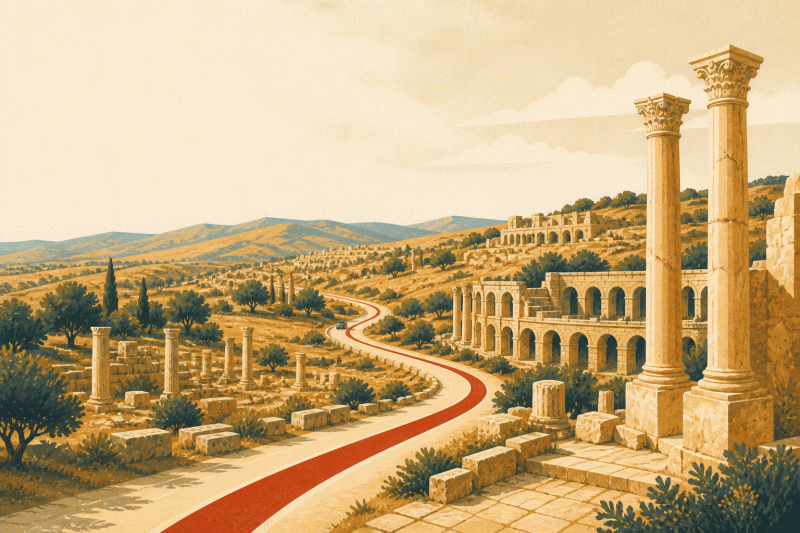
Dougga and Testour
A day in the Medjerda valley: the best-preserved Roman town in North Africa in the morning, a small town founded by Andalusian exiles in the afternoon, and a vehicle nobody shares with you in between.
Two Roman cities in one day: Dougga up in the wind on its hillside, then Bulla Regia, where people went underground to live, with the mosaics still lying where they were laid.
On request
Duration
A long day, roughly 11 to 12 hours and close to 350 kilometres in all.
Who it suits
Committed archaeology and mosaic enthusiasts, repeat visitors to Tunisia, comfortable walkers, and groups who would rather have one big full day than two half-hearted half-days.
Price
On request
A long day for people who genuinely love archaeology. The morning goes to Dougga, its capitol facing the valley and its Numidian mausoleum among the olives. The afternoon runs west to Bulla Regia, where a stone stair takes you down into buried rooms that stay cool in August, their mosaic floors never lifted.
Pick-up
Greater Tunis: Tunis-Carthage airport, your hotel, a guesthouse or a private address, with an early morning start. Hammamet, Nabeul or the northern suburbs: workable, but it stretches an already long day, and we say so plainly before we plan it.
The order of the stops shifts with your start time, the traffic and how long you want to spend at each place.
Dougga
An early start out of Tunis, the road running west through the wheat of the Medjerda before climbing to Teboursouk. Dougga appears all at once, tiered up its slope above the Oued Khalled valley. You walk it for two or three hours in the cool of the morning: the columned front of the capitol, the theatre cut into the hillside with open country as its backdrop, the Square of the Winds with its compass rose in the paving, the baths, the arch of Septimius Severus, and lower down the Libyco-Punic mausoleum, the only one of its kind, a reminder that this was a Numidian town before it was Roman.
Bulla Regia
Ninety minutes west through grain country and Jendouba to a site that resembles nowhere else. At ground level Bulla Regia looks like a standard Roman town: forum, temples, theatre, the baths of Julia Memmia. But its wealthier families had a whole storey dug below the surface, arranged around a light well, to escape the summer heat of the plain. You go down into the House of the Hunt, the House of Amphitrite, the House of the Peacock: the columns still stand, the air turns cool in a single step, and the mosaics are there under your feet, exactly where they were laid.
Beja
On the way home, a short halt at Beja, the wheat capital clinging to its hillside, kasbah at the top, red roofs tumbling below and grain silos that tell you everything about this region. Long enough for a coffee outside, to stretch your legs and watch the plain change colour towards evening, then the road drops back to Medjez el Bab and Tunis. Drop-off at your hotel, the airport or the address agreed, at the time settled with you in the quote.
It is a dense day and we will not pretend otherwise: some 350 kilometres and a great deal of walking. It works well if we start early and archaeology genuinely holds you. If not, there are two options: pair Dougga with Testour, which is nearer and gentler, or spread Dougga, Bulla Regia and Chemtou across a two or three day tour with a night out there.
Because the Medjerda plain is an oven in summer. Wealthier families had an entire storey dug below ground level, arranged around a light well that brings in daylight and air without direct sun. Those rooms stayed sheltered from rain, frost and looting, which is why you can walk today on mosaics that have never been moved.
Closed shoes with grip, a hat, sun cream, plenty of water, and a small torch for the underground rooms. In winter add a jacket: the hill at Dougga is cool and the buried rooms cooler still. Everything else stays in the vehicle between visits.
A day in the Medjerda valley: the best-preserved Roman town in North Africa in the morning, a small town founded by Andalusian exiles in the afternoon, and a vehicle nobody shares with you in between.
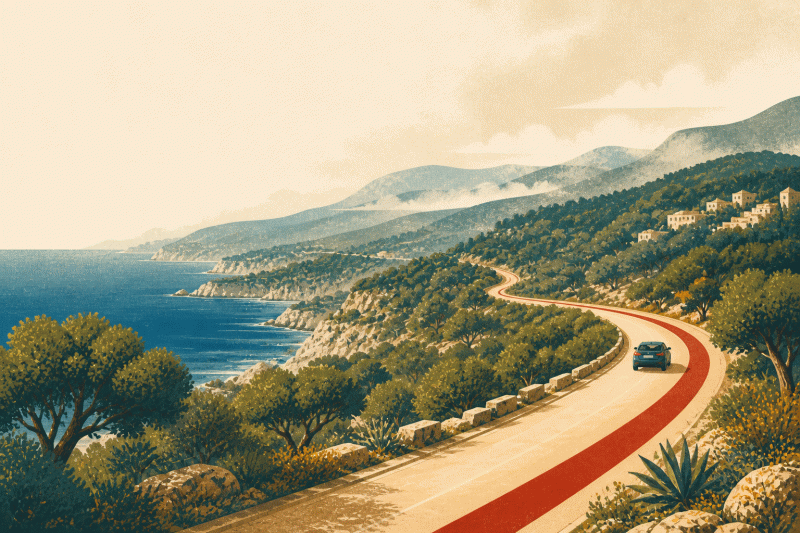
A day in the Kroumirie: cork oaks, cool forest air, and the sea below a Genoese fort.
Five days among Roman and Numidian sites, in a vehicle kept for your group alone, from Carthage down to El Jem.
Four days in a Tunisia of water and woodland: bird-filled lakes, cork oaks, coral coves and mountain villages, nowhere near the desert everyone expects.
Give us the date, how many of you are travelling and your pick-up address: we reply with a quote drawn up for this day out.
Fields not marked optional are needed to prepare a quote.
Every journey is quoted individually: no price is shown before your own quote.