
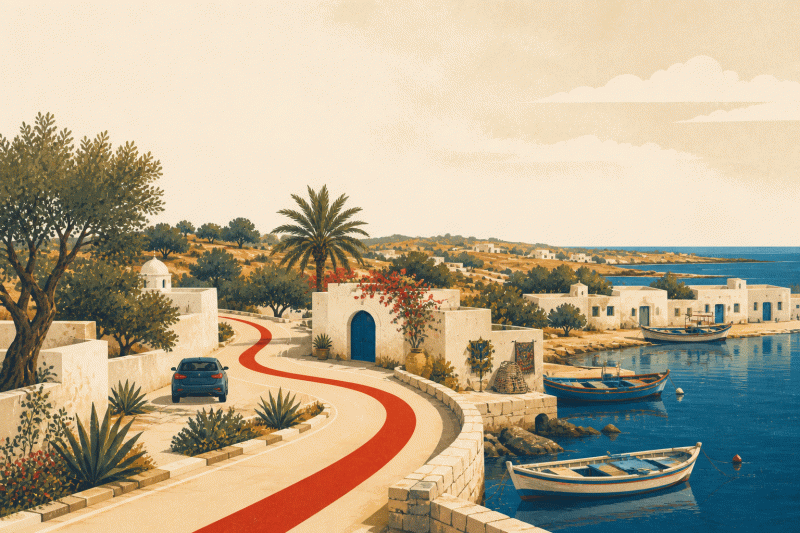
Cultural Djerba
A day that shows the island beyond its beaches — the market at Houmt Souk, El Ghriba at Erriadh, the potters of Guellala and the lagoon — in a vehicle kept for your group alone.
Island first, mainland after: Houmt Souk, El Ghriba and the potteries, then the causeway to Medenine, Tataouine and the ksour, in a vehicle kept for you.
On request
Duration
4 days and 3 nights: two days on the island, two on the mainland, including a night in the south.
Who it suits
Anyone staying on the island who wants more than the beach — couples, families, and travellers with an eye for craft and heritage. Easy walking throughout, apart from the climb at Chenini.
Price
On request
Four days linking two neighbouring worlds with very little in common. Djerba first — whitewashed fondouks, the El Ghriba synagogue, the pottery kilns of Guellala, the sponge harbour at Ajim — then over the causeway for the ghorfas of Medenine, Tataouine and the ridge villages. One vehicle, one driver, a pace you set as you go.
Departures
On Djerba, pick-up is from your hotel, your guesthouse, a private address or the port, at a time agreed with you in the quote. From Zarzis, Medenine, Gabes or Tataouine: we collect you at your accommodation and reorder the days to suit where you are starting.
A working plan rather than a fixed track: the order of the days is reworked with you before departure, and on the road wherever that is practical.
Day 1 — Houmt Souk and the north of the island
The first day is spent at walking pace: the old fondouks of Houmt Souk with their arcaded courtyards, the fish market, the white lanes where wool and silver are still traded. On the shore, the Borj El Kebir watches the harbour entrance. If you fancy it, the day ends out at Ras R'mel and its spit of sand.
Day 2 — Erriadh, El Ghriba, Guellala and Ajim
Erriadh, for the El Ghriba synagogue, one of the oldest in the Mediterranean basin, and for the painted walls of Djerbahood in the same village. The afternoon goes to Guellala and its buried kilns, where grey clay becomes storage jars. Back via Ajim, the sponge fishermen's harbour, with its boats sitting on the mud at low tide.
Day 3 — The causeway, Medenine and Tataouine
You leave the island by the El Kantara causeway, laid along an old Roman crossing, and within an hour the country changes: olive groves, dry plain, then the first hills. We stop at the ksour of Medenine, where stacked ghorfas still frame the old centre. The night is in Tataouine, with Ksar Ouled Soltane late in the day, when the courtyard turns properly ochre.
Day 4 — Chenini, Douiret and back to Djerba
The morning is for the ridge villages: Chenini clinging to its crest, granaries above the houses, the white Mosque of the Seven Sleepers below, then Douiret if there is time, quieter still. The way back to Djerba runs either over the Jorf to Ajim ferry or across the causeway, ending at the drop-off point agreed in advance.
From your hotel, your guesthouse, a private address or the port, whichever suits you. Give us the exact place when you ask for a quote, and the time is settled with you then, according to the programme and the season.
Yes, outside services, with a security check at the door, shoulders and knees covered, shoes off and a head covering lent to men. Days and hours shift, particularly on Saturdays and during Jewish festivals, so we confirm before the day's running order is fixed.
It changes the whole trip. Doing Medenine, Tataouine and the ridge villages as a day return from the island means spending most of it in the car. Sleeping in Tataouine gives you the ksour in late light and Chenini first thing, before the heat arrives.
A day that shows the island beyond its beaches — the market at Houmt Souk, El Ghriba at Erriadh, the potters of Guellala and the lagoon — in a vehicle kept for your group alone.
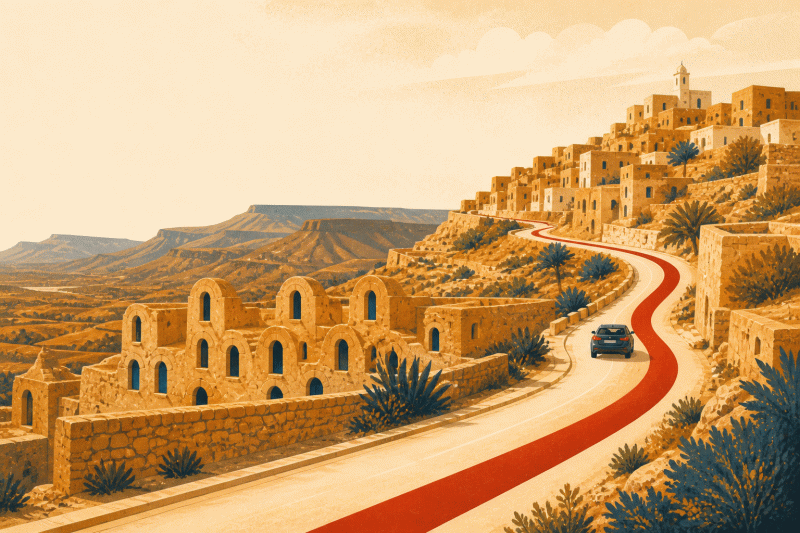
Four days across Tunisia's south-east in a vehicle kept for your group alone — fortified granaries, the ridges of the Dahar, villages that are still lived in.
Three villages, three ways of living on a dry mountain — Matmata below ground, Tamezret on its ridge, Toujane above its gorge — in a vehicle kept for your group alone.
A day among the fortified granaries of the south-east, in a vehicle kept for your group alone: Ksar Ouled Soltane, Chenini along its crest, near-silent Douiret and Tataouine itself.
Your dates, how many of you are travelling and where you start are enough to begin: we come back with a quote drawn up for this tour.
Fields not marked optional are needed to prepare a quote.
Every journey is quoted individually: no price is shown before your own quote.